





Research & Nutrition
Food & Recipes
Innovation
Activism & Animals
Law & Policy
Wins & Culture
June 20, 2026
EU Parliament votes to ban meat terms on plant-based labels

Vegan Brief June 20, 2026

EU bans plant-based meat terms; 65 orgs petition FDA on antibiotics

The EU Parliament voted by a large majority to ban plant-based products from using meat-related terms like "burger" and "sausage," reserving that language for animal products across EU markets.

5 top stories 52 sources read 447 articles scanned 6 sides of vegan life
Lead story EU Parliament votes to ban meat terms on plant-based labels Read the story

The Quick List

The EU Parliament voted by a large majority to ban plant-based products from using meat-related terms like "burger" and "sausage," reserving that language for animal products across EU markets. [162]
Sixty-five organizations, including Earthjustice, Sierra Club, and Mercy For Animals, filed a formal FDA petition to pull livestock antibiotic approvals, citing 34 million pounds used annually and 35,000 US deaths per year from resistant infections. [328]
Ontario's Court of Appeal reinstated the province's ag gag law, reversing a 2024 lower court ruling that had struck it down as unconstitutional. [406]
A structural collapse at a confirmed Vital Farms supplier in Kansas trapped over 20,000 hens; PETA rescued 36 birds and alleges the farm was instructed to gas the rest. [329]
Precision fermentation startup Vivici secured €12.5M in EIC Accelerator funding as whey protein prices have climbed more than 50% since January, making animal-free dairy proteins a genuine procurement alternative. [189]

The Rundown

The EU Parliament voted this week to ban plant-based products from using meat terminology, reserving words like "burger," "steak," and "sausage" for animal products across one of the world's largest food markets. The vote passed by a large majority. For brands selling in Europe, this is a naming problem that goes down to the shelf level: these terms are how shoppers find products, compare them to what they already eat, and decide whether to try something. The livestock lobby has pushed for exactly this for years. This week, it won.

Two other institutional moves worth noting. A coalition of 65 organizations including Earthjustice and Mercy For Animals filed a formal rulemaking petition asking the FDA to withdraw approvals for antibiotics used in livestock feed and water, citing 34 million pounds used annually and 35,000 US deaths per year from resistant infections [328]. Separately, Ontario's Court of Appeal reinstated the province's ag gag law, overturning a 2024 ruling that had struck it down [406].

The science tier today carries three studies: a flavanol analysis showing fewer than one in five UK and US adults reach the 500mg clinical-trial threshold for cardiovascular benefit [21], a beet juice blood pressure trial finding measurable reductions in older adults (not younger ones) via oral microbiome changes [56], and a MIT mouse study linking dietary cysteine to intestinal stem cell regeneration [58]. All three are under Worth Knowing.

01InnovationStory

EU Parliament votes to ban meat terms on plant-based labels

What happened: the record

The European Parliament voted, by a large majority, to ban plant-based food products from using meat-related terminology. Words like "burger," "sausage," and "steak" would be reserved for animal products under the measure, which is part of the EU's Common Agricultural Policy framework revision. [162]

Why it matters

These terms are how consumers navigate supermarket shelves, compare products to food they already eat, and decide whether to try something new. The livestock industry has spent years arguing that plant-based products using meat vocabulary mislead shoppers. Industry and consumer research has consistently found that no meaningful share of buyers picks up an oat-based patty and mistakes it for beef. The ban passed regardless. European plant-based brands now face a packaging redesign problem that runs to the shelf level, not just the logo. The cultivated meat sector, still waiting on EU approval for any product, faces the same terminology restriction even before it reaches a consumer.
02Activism & AnimalsStory

65 organizations petition the FDA to pull livestock antibiotic approvals

What happened: the record

A coalition of 65 organizations, including Earthjustice, the Sierra Club, Consumer Reports, and Mercy For Animals, filed a formal rulemaking petition asking the FDA to withdraw its approvals for antibiotics used in livestock feed and water for disease prevention and for durations that exceed medical necessity. The petition also requests that the FDA collect species- and sector-specific antibiotic usage data and set measurable reduction targets. US livestock operations use approximately 34 million pounds of antibiotics annually. The CDC estimates antibiotic-resistant infections cause 35,000 deaths and 2.8 million illnesses per year in the US. [328]

Why it matters

A rulemaking petition is a formal legal mechanism, not a press release. The FDA is required to respond. The current regulatory environment makes a fast resolution unlikely, but the organizations filing this include groups with real litigation capacity, and the numbers in the petition are drawn from official statistics: 34 million pounds, 35,000 deaths, 2.8 million illnesses. Those hold up in court. What the petition is trying to force is data collection the industry has resisted and reduction targets the FDA has never set. Both would make the problem legible and trackable in ways it currently is not. That is exactly the kind of accountability mechanism the industry does not want.

03InnovationStory

Precision fermentation finds a willing market as whey prices spike

What happened: the record

Danish startup Vivici raised €12.5M in EIC Accelerator funding for Vivitein, its precision fermentation dairy-identical protein, following a €32.5M Series A in February 2025. US startup Alpine Bio was separately selected for Mondelēz International's 2026 CoLab Tech accelerator with its fractionated soy protein isolate, designed to perform the functional roles of whey in food manufacturing. The backdrop: standard whey powder prices are up more than 50% since January 2026, whey concentrate has roughly doubled over two years, and some suppliers are sold out for the rest of the year. Alpine Bio's lifecycle analysis shows its product at roughly 2.4 kg CO2e per kilogram; whey concentrate runs about 16 kg CO2e. [189], [185]

Why it matters

Whey protein has been the food industry's default functional ingredient for decades: cheap, reliable, well-understood. When your supplier tells you there is nothing available until 2027, the ethics of alternative proteins become beside the point. The question becomes whether the alternative actually works. Vivici's protein is chemically identical to dairy whey. Alpine Bio's soy isolate is engineered to replicate whey's functional behavior in food systems. Neither company is pitching on ethics alone right now. The market is pulling.

04Law & PolicyStory

Ontario's Court of Appeal reinstates the province's ag gag law

What happened: the record

Ontario's Court of Appeal overturned a 2024 Superior Court ruling and reinstated the Security from Trespass and Protecting Food Safety Act. The law, passed in 2020 under the Ford government following industry lobbying, makes it illegal to take employment at a farm or slaughterhouse under false pretenses. The Superior Court had found it unconstitutional. Animal Justice, which brought the original challenge, says it is considering an appeal to the Supreme Court of Canada. Ag gag laws of this type have been struck down as unconstitutional in six US states. [406]

Why it matters

Undercover investigations at farms and slaughterhouses have produced most of the footage that has driven public awareness of factory farming conditions in Canada and the US. The Ontario law is designed to stop that by criminalizing the act of taking farm employment in order to document conditions inside. The 2024 Superior Court ruling was a genuine win for transparency. The Court of Appeal reversal makes it temporary. Animal Justice is weighing a Supreme Court appeal. In six US states, similar laws have already been struck down. Canada's highest court has not had the chance to rule on this category of legislation.

05Activism & AnimalsStory

A Vital Farms supplier's shed collapsed. PETA got there before the gas trucks.

What happened: the record

A structural collapse at Triple C Infinity Eggs, a farm in Winfield, Kansas and a confirmed Vital Farms supplier, trapped more than 20,000 birds. Burst water lines flooded the wreckage. PETA investigators responded and rescued 36 hens, documenting debeaked birds approximately seven months old, including one hen with a cracked beak and one with a foot deformity. PETA says the farm owner informed them that Vital Farms had instructed the farm to gas the surviving birds. PETA has an ongoing shareholder campaign against Vital Farms, which markets its eggs as coming from pasture-raised "happy hens." Vital Farms has not confirmed PETA's account. [329]

Why it matters

Vital Farms sells on a specific premise: better conditions, happier animals, a supply chain worth paying more for. The gap between that premise and a supplier being instructed to gas 20,000 trapped birds is exactly the kind of thing that travels in a consumer story. The debeaking finding matters separately. Debeaking is standard in conventional egg production and exists to prevent pecking behavior caused by crowding and stress. Finding it at a Vital Farms supplier tests the brand's central claim about how its animals actually live. PETA's shareholder position means these questions will get asked in public settings where Vital Farms has to respond.

Food & Recipes

  • On the plate this week: Vegan Butter Chicken from Full of Plants, firm tofu torn (not cut) and double air-fried with a yogurt marinade, then finished in coconut milk and tomato with ginger. The two-step cooking process is worth it. [63]
  • NYC Mayor Zohran Mamdani appointed Siddhartha Sanchez, a lifelong vegan, as executive director of the Mayor's Office of Food Policy, which sets school lunch programs and plant-based eating policy for eight million people. [151]
  • Lidl is selling vegan seaweed-pearl caviar for around $2 a jar. [151]
  • Starbucks brought back its Unicorn Frappuccino, customizable with plant milk. [151]
  • Daily Harvest launched World Cup-themed smoothie blends. [151]
  • A plant-forward restaurant called Mother Other opened in Denver. [151]
  • LesbiVeggies, a vegan community space, opened in Camden, New Jersey. [151]

Innovation

  • UPSIDE Foods placed a $50M stalking horse bid for Believer Meats' US assets, including its North Carolina facility. Competing bids due July 20, auction July 28; Believer entered receivership after ceasing operations in December. [163]
  • Solar Foods, the Finnish company producing protein from CO2 and electricity, raised €89.2M. [162]
  • SWAP Food, a French cultivated meat startup, entered judicial liquidation. [162]
  • Heura, the Spanish plant-based brand, won a legal battle in Spain. [162]

Research & Nutrition

  • A 2025 case-control study found a U-shaped relationship between blood B12 and cancer risk, but high blood B12 is often an early sign of existing cancer rather than a cause. Supplement at recommended doses; avoid megadoses. [55]
  • Fewer than one in five UK and US adults reach 500mg of flavanols daily, the threshold shown in clinical trials to benefit cardiovascular health. Top plant sources: plums, cranberries, blackberries, green tea, broad beans. [21]
  • Beet juice lowered blood pressure in older adults but not younger ones in a University of Exeter trial; the mechanism is the oral microbiome (increased Neisseria, decreased Prevotella), not direct nitrate processing. [56]
  • A MIT mouse study found dietary cysteine, abundant in legumes and nuts, supports intestinal stem cell regeneration via a CoA-to-IL-22 signaling pathway. Promising for cancer treatment recovery research, still at the animal stage. [58]

New York City has a new executive director of its Mayor's Office of Food Policy: Siddhartha Sanchez, a lifelong vegan, appointed by Mayor Zohran Mamdani. [151]

The Mayor's Office of Food Policy is not a ceremonial post. It shapes school lunch programs, food access initiatives, and plant-based eating policy across a city of eight million people. The last time a lifelong vegan held a comparable position in a major American city's food policy apparatus is not a question with an obvious answer. The appointment does not guarantee any specific policy outcome. It does put someone at that table who does not need to be persuaded that plant food is viable. Sometimes that is how change actually starts.

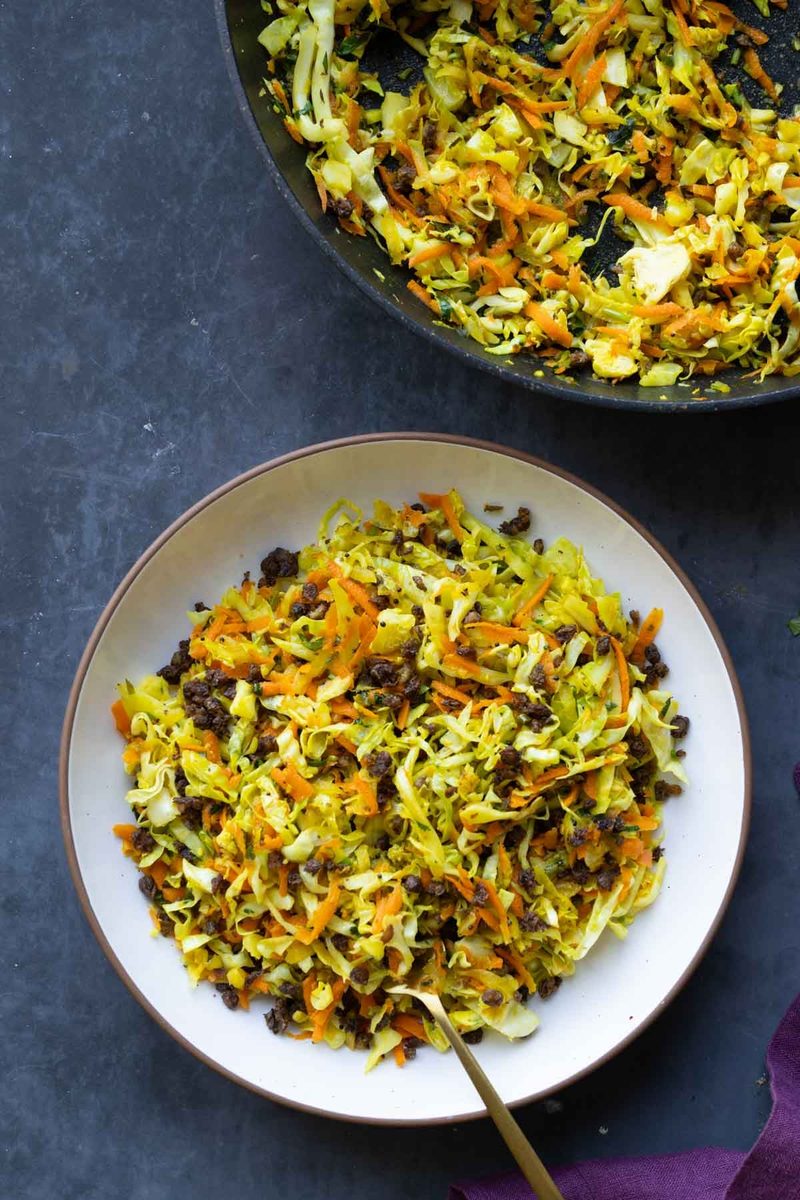
Sambharo (Indian Spiced Cabbage Salad)

Recipe of the day · Vegan Richa

Sambharo (Indian Spiced Cabbage Salad)

This warm cabbage carrot beet salad, with a wildly flavorful golden garlic green chili oil, is full of flavor, fiber and texture! Inspired by Indian sambharo, it has shredded…

40 min 4 servings 20 ingredients
See the ingredients
  • 1/2 head green cabbage (finely sliced or shredded, 2 cups )
  • 1 medium carrot (shredded, grated, or finely chopped)
  • 1 golden beet (peeled and shredded, grated, or finely chopped)
  • 1/2 red bell pepper (thinly sliced (optional))
  • 1/2 cup thinly sliced fennel (or other vegetables of choice (optional))
  • 1 tablespoon oil
  • 1 teaspoon brown or black mustard seeds
  • 2 green chilies (finely chopped, Such as Serrano or Indian, or use mild green chili for less heat)
  • 10 to 12 curry leaves (chopped. Fresh, frozen, or dried are all fine to use.)
  • 3 cloves garlic (finely chopped)
  • 1/2 teaspoon salt (divided)
  • 1/2 teaspoon turmeric
  • zest of 1/2 lime
  • 1 to 2 tablespoons lime juice
Get the full recipe at Vegan Richa →
This week in vegan history Cultivated meat goes on sale in America 2023 UPSIDE Foods and GOOD Meat received USDA grants of inspection, clearing cultivated chicken for sale in the United States. Twenty-five centuries of the idea →