

On this day in vegan history · October 11, 1805
The Man Who Read Rousseau and Gave Up Meat
A future street-fighting revolutionary is born in Munich, decades before he trades the barricades for a plate of vegetables and a Stuttgart meeting hall.
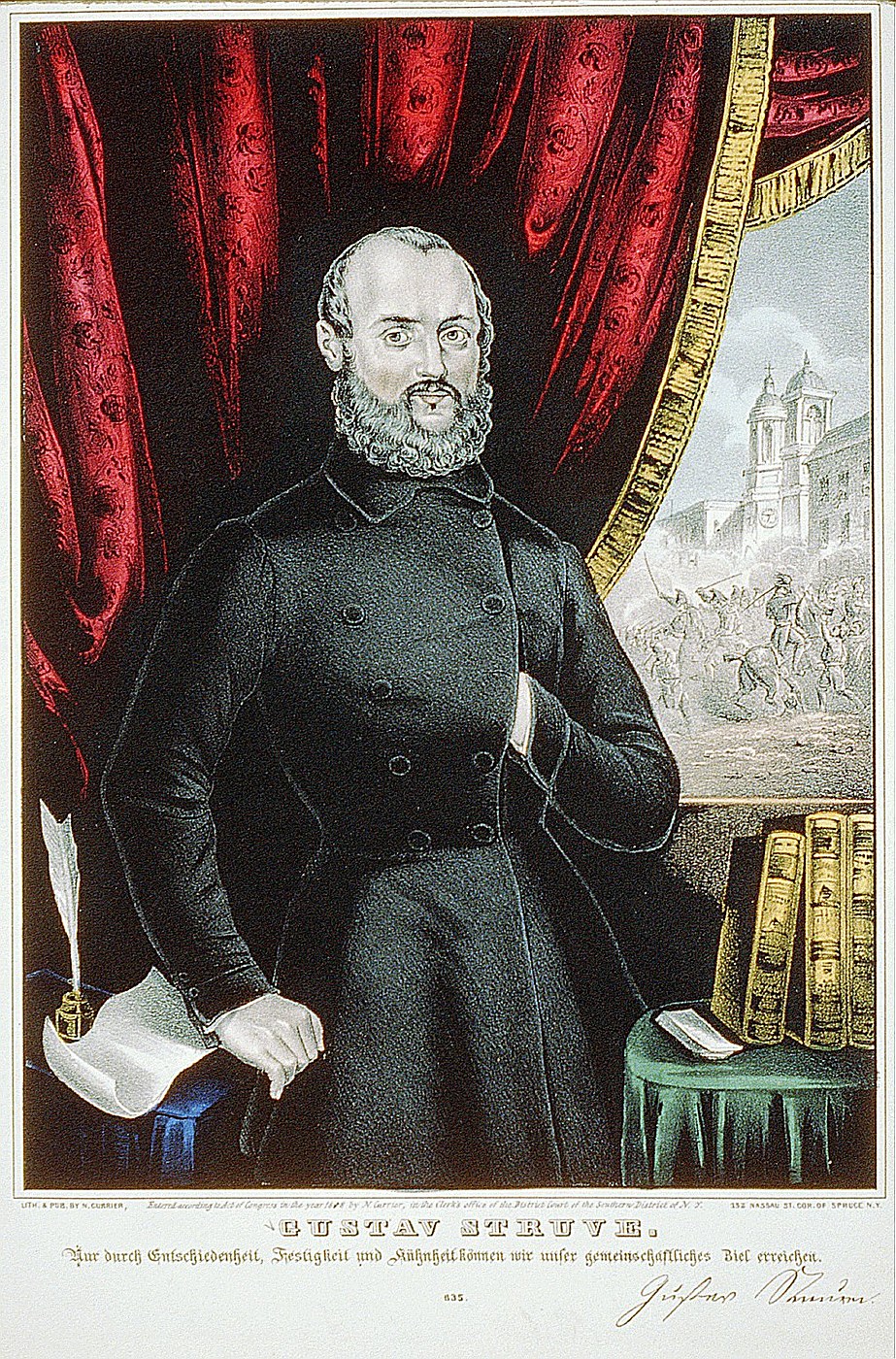
The facts
- Born
- 11 October 1805, Munich, Electorate of Bavaria
- Turned vegetarian
- 1832, after reading Rousseau's Emile
- Founded
- Vegetarische Gesellschaft Stuttgart (Stuttgart Vegetarian Society), 1868
- Died
- 21 August 1870, Vienna
Gustav Struve was born on 11 October 1805 in Munich, and grew up to become a German surgeon, lawyer, publicist, and revolutionary who led the radical democratic wing of the 1848 uprisings in Baden alongside Friedrich Hecker. In 1832, well before the barricades, he became a vegetarian after reading Jean-Jacques Rousseau's Emile. He carried that conviction into print in 1833 with Mandaras Wanderungen, the first German vegetarian-themed novel, whose protagonist is a young Brahmin scandalized by Europeans who preach Christian mercy while eating meat and hanging criminals. Decades later, in 1868, he founded the Vegetarische Gesellschaft Stuttgart, one of Germany's first organized vegetarian societies, and in 1869 published Pflanzenkost, die Grundlage einer neuen Weltanschauung, arguing plant-based eating as the foundation of a new worldview.
In their words
The day in the words of the people who were there. Every quote is verbatim, and every source links out so you can check it.
-
He had become a vegetarian in 1832 under the influence of Rousseau's treatise Émile.
Wikipedia, on Gustav Struve
Source: Wikipedia -
Some, such as Struve, cited the improved temperament of vegetarians and drew the conclusion that war would become impossible among nations of plant-eaters.
Carolyn Taratko, "Eating for Others: The Nineteenth-Century Vegetarian Movement in Germany," JHI Blog, 2016
Source: JHI Blog
Why it still matters
Struve shows how early the case for plant-eating got tangled up with the case for a fairer world: he treated giving up meat as part of the same project as democracy and peace, not a separate lifestyle choice, and the society he founded helped seed organized vegetarianism in Germany.
Sources
This history is still being written.
Every morning the brief covers what moved veganism forward, and every day one more verified piece of that story joins this almanac. Free, and tomorrow’s lands in your inbox.
Free, every morning. No guilt. No preaching.